

Integrated Multidisciplinary Teams
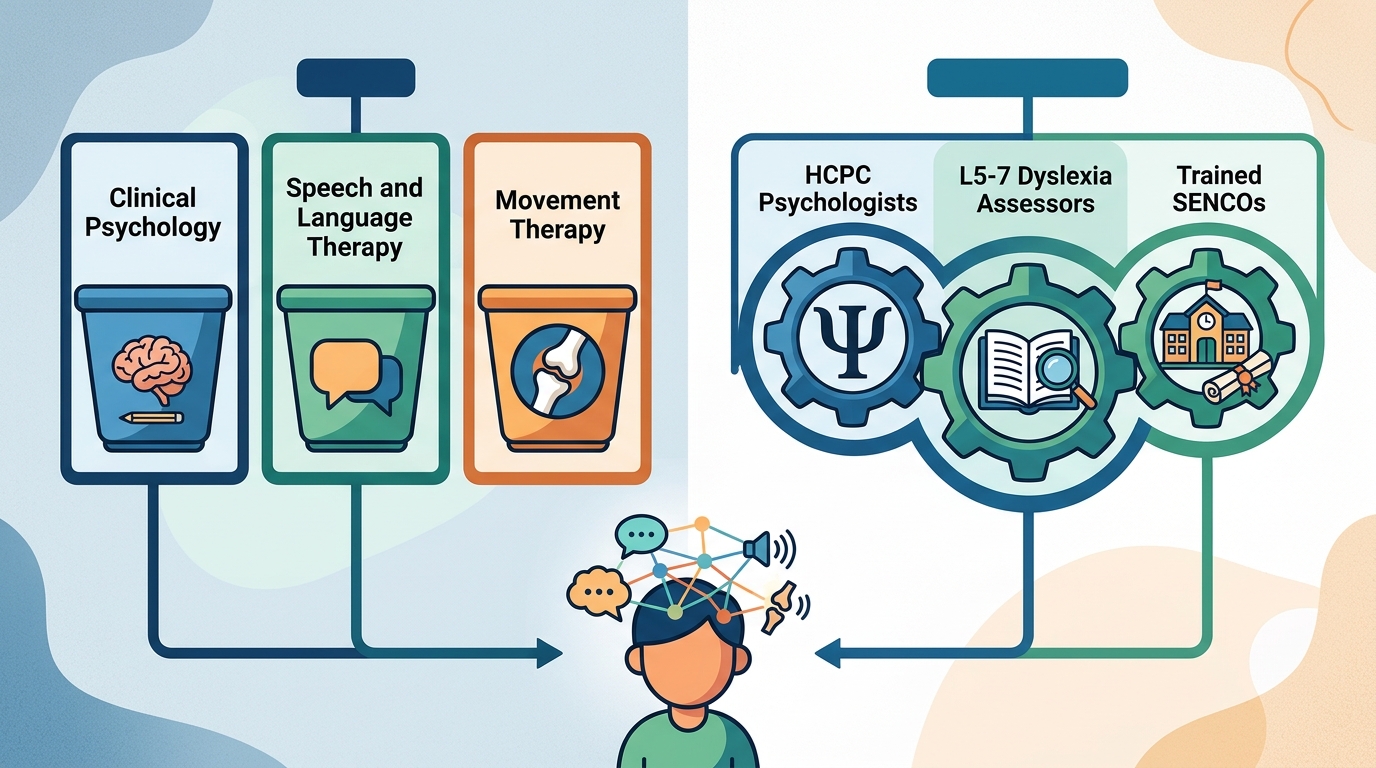
An integrated multidisciplinary team is a group of specialists from different disciplines who work collaboratively on a single case. In this model, a clinical psychologist, a speech and language therapist, and a movement therapist share the same client file and communicate directly. Learning DNA exemplifies this approach, uniting HCPC psychologists, L5-7 Dyslexia Assessors, and trained SENCOs into one cohesive unit. This structure ensures that a child’s cognitive profile, sensory needs, and communication skills are assessed simultaneously rather than in isolation.
The primary strength of this model is the elimination of information silos. When specialists work together, they can identify complex overlaps, such as how auditory processing difficulties might mask a dyslexia diagnosis. The limit of this approach is that it requires significant internal coordination and a larger team size to function effectively. This model suits families who want a single point of contact and a comprehensive, 360-degree view of their child’s learning profile.
Fragmented Single-Specialist Models
A fragmented single-specialist model is a service structure where each specialist operates independently, often requiring separate referrals for different needs. In this setup, a parent might see a psychologist for ADHD, a separate clinic for speech therapy, and another provider for occupational therapy. These providers rarely share data or coordinate their findings. The strength of this model is that it can be more accessible for very specific, isolated issues where a single specialist is sufficient. For additional details, review the Help amp Advice for.
However, the major limitation is the lack of holistic insight. A child may receive three different reports that contradict each other or fail to address the root cause of their struggles. This model suits families who have a very clear, single diagnosis and do not require cross-disciplinary support. It is less ideal for children with complex, overlapping neurodivergent traits.
Comparison of Clinic Team Structures
| Criteria | Integrated Multidisciplinary (e.g., Learning DNA) | Fragmented Single-Specialist |
|---|---|---|
| Communication Flow | Direct, real-time collaboration between all specialists | Minimal or no communication between separate providers |
| Diagnostic Scope | 360-degree assessment covering cognitive, sensory, and communication | Narrow focus on a single domain (e.g., only ADHD) |
| Time to Plan | Faster, as all data is synthesized in one report | Slower, requiring multiple separate appointments and reports |
| School Integration | Direct support for SENCos with unified SEND tracking | Requires the school to manually stitch together multiple reports |
| Best For | Complex cases, schools, and families wanting a unified plan | Simple, isolated issues with a clear single diagnosis |
Choose an Integrated Team If...
Choose an integrated multidisciplinary team if your child presents with overlapping symptoms that do not fit neatly into one category. This is particularly relevant for children who are "fine at school but falling apart at home," as this often indicates a complex interplay of masking, sensory processing, and executive function issues. If you are a school SENCo, an integrated model is essential for managing the SEND register efficiently. Learning DNA’s school services are designed to handle the entire SEND loop, from assessment to tracking, ensuring that data flows seamlessly between the clinic and the classroom.
Choose a Fragmented Model If...
Choose a fragmented single-specialist model if your child has a very specific, well-understood need, such as a simple speech delay, and you already have a clear diagnosis. This approach may also be suitable if you are located in an area where integrated clinics are not available and you are willing to manage the coordination burden yourself. However, be aware that switching from a fragmented model to an integrated one later can be costly and time-consuming, as you may need to repeat assessments to get a holistic view.
Frequently Asked Questions
Can I switch from a fragmented clinic to an integrated one?
Yes, but it may require re-assessment. Integrated clinics often need to see the full picture, so they might repeat some tests to ensure their data is consistent with their holistic approach. This can add to the cost and time involved.
Do integrated clinics cost more than single-specialist clinics?
Not necessarily. While the initial assessment might be more comprehensive, the integrated model often saves money in the long run by preventing the need for multiple separate referrals and therapies that do not work together.
How do integrated teams handle school referrals?
Is an integrated team better for ADHD and Autism co-occurrence?
Yes. Because ADHD and Autism often present with overlapping symptoms, an integrated team can better distinguish between the two and provide a more accurate diagnosis and support plan.
What if I only need speech therapy?
If you only need speech therapy, a single-specialist model might be sufficient. However, if your child also has learning difficulties, an integrated team can ensure that the speech therapy is aligned with their broader cognitive profile.
Conclusion
The structure of a neurodiversity clinic’s team is a critical factor in the quality of care your child receives. An integrated multidisciplinary team provides a holistic, efficient, and coherent approach to diagnosis and support. Learning DNA offers this integrated model, combining clinical expertise with practical school support. To determine if this structure is right for your child, book a free consultation with our team today.